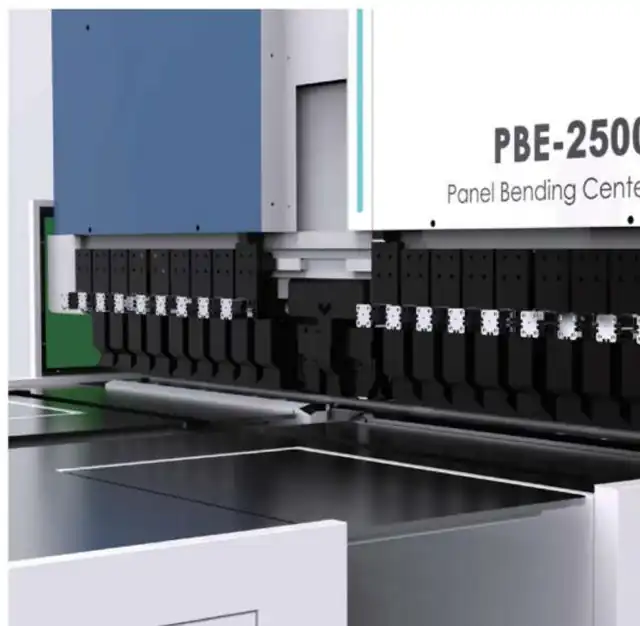
Faster than a press brake on box-type parts
On a press brake the operator lifts and turns the sheet for every bend and changes tools between jobs. On a panel bender the machine does the handling and one operator runs it.
One set-up, four sides
The manipulator rotates the sheet to any angle, so all edges are bent in one continuous cycle.
Universal tooling
The same blades make up, down, hem and large-radius bends without turning the sheet over or changing tools.
Repeatable accuracy
Every axis is servo-driven with a 0.001 mm control unit. Angle ±0.5°/m and straightness ±0.2 mm/m (PBE-1400 data).
Less skilled labour
Import a .STEP file and the CNC programs the sequence, runs a 3D simulation and checks for tool collisions before bending.
How the panel bender forms a sheet
The blank holder clamps the sheet and the upper and lower blades bend the edge. The manipulator then turns the part for the next side, with no operator handling between bends.
- Bends up to 135° in one stroke; 135–180° by hemming
- Auxiliary short blades for broken or offset bend lines
- Segmented and horn blank holders for inward bends and special shapes
- 21.5" industrial touch screen with 2D/3D graphical programming
Finish complex parts in one set-up
The blades move along interpolated paths to make each bend. These are the bend types the universal tooling makes:
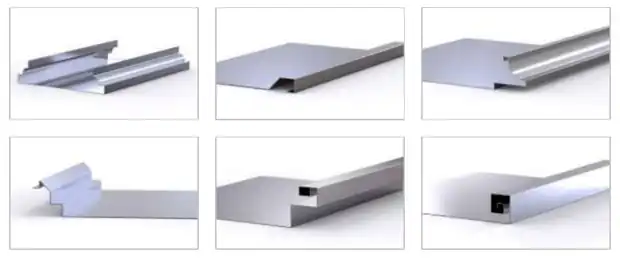
Typical parts
- Return flanges and C-channels on long panels
- Hemmed safety edges on doors and covers
- Box sections and four-side trays
- Large-radius curved facade and elevator panels
- 90° and non-90° bends in the same part
Who uses a panel bender
Any factory that makes a lot of flat panels with bent edges, in stainless steel, mild steel, aluminium or copper.

Choose the model by your largest panel
The PBE-1400 suits compact enclosures and doors. The PBEH-2500 ATC handles full-size switchgear panels, with automatic tool change and ready for robot loading.
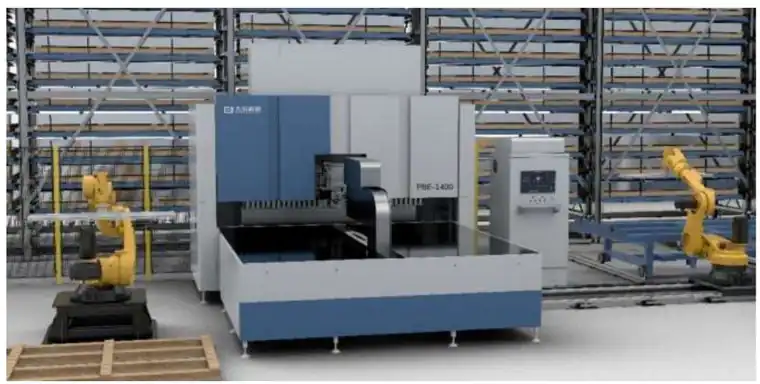
PBE-1400
1400 mm bending length28 / 38 TStandard & heavy-dutyFor compact panels, enclosures, doors and trays up to 1400 × 1400 mm.
PBEH-2500 ATC
2500 mm bending length115 TAutomatic tool change20 CNC axesFor large switchgear and cabinet panels up to 2500 × 1500 mm, with high throughput.
| Specification | PBE-1400 | PBEH-2500 ATC |
|---|---|---|
| Capacity | ||
| Max. bending length | 1400 mm | 2500 mm |
| Max. sheet width | 1400 mm | 1500 mm |
| Max. bending height | 170 mm (optional up to 400 mm) | 200 mm |
| Min. bending height | — | 20 mm |
| Min. workpiece size | 200 mm (4 sides) / 170 mm (1 side) | 240 mm (2 sides) / 260 mm (1 side) |
| Bending angle | ±135° | ±130° |
| Max. rotating diameter | — | 2800 mm |
| Positioning width | — | 200 – 2520 mm |
| Sheet thickness | ||
| Min. thickness | 0.35 mm | 0.35 mm |
| Max. stainless steel | 1.0 / 1.5 / 2.0 mm* | 1.5 mm |
| Max. mild steel | 1.5 / 2.0 / 3.0 mm* | 2.0 mm |
| Max. aluminium | 2.0 / 3.0 / 3.5 mm* | 3.0 mm |
| Force & power | ||
| Max. pressing force | 28 T (standard) / 38 T (heavy duty) | 115 T |
| Power | 36 kW (standard) / 40 kW (heavy duty) | 62 kW |
| Supply | 380 V ±10%, 3-phase | 380 V, 50 Hz, 3-phase |
| Accuracy & features | ||
| Angle / straightness accuracy | ±0.5°/m / ±0.2 mm/m | On request |
| Automatic tool change | — | Yes (min. adjustment 10 mm) |
| Auxiliary short blades | Yes | Yes |
| Arc, hem & robot-connection commands | Standard | Standard |
| Feeding / table | Servo manipulator, brush table | Arm-hold dual rotate, brush table |
* Depends on version: standard (PBE), heavy-duty (PBEH) or super-heavy (PBESH). Specifications may change with technical updates; confirm with the final offer.
CNC system (both models)
- 21.5" industrial touch screen, EtherCAT high-speed bus control
- Direct .STEP 3D import with automatic programming
- Real-time 3D bending simulation and collision detection
- Built-in bending compensation database, 0.001 mm control unit
Branded components
- Schneider electricals, Nachi bearings
- HIWIN / Gongyi ball screws, PMI / Yigong linear guides
- Nidec planetary reducers, Veichi servo motors & drives
- Airtac pneumatics, Givi / Opkon position sensors
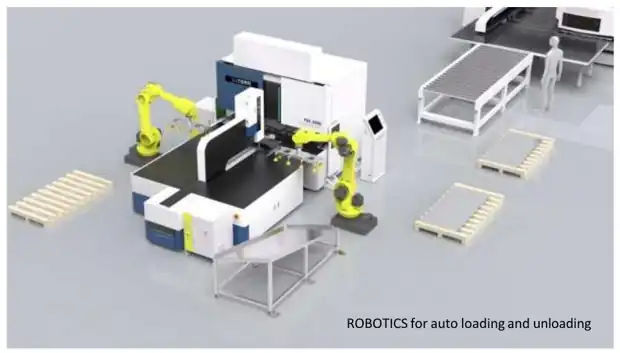
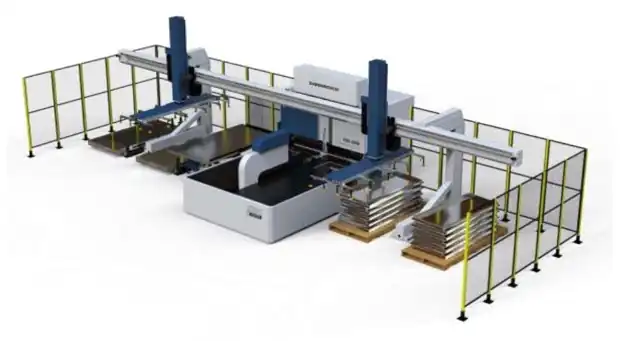
Grow into a lights-out bending cell
Start with a stand-alone machine and add automatic loading and unloading later, when your volumes justify it.
What your site needs
We check these with you before dispatch so installation and training go smoothly.
Floor
Concrete at least 20 cm thick. Otherwise a foundation is prepared to drawing.
Power
380 V AC, 50 Hz, 3-phase 4-wire (neutral essential), 3×16 mm² + 1 cable.
Air
0.6–0.8 MPa compressed air, 12 mm PU line at the machine.
Operators
2–3 people with basic PC, CAD and CNC bending knowledge for training.
Handling
A 20–30 tonne crane for unloading and placing the machine.
Panel bender – common questions
What is the difference between a panel bender and a press brake?
On a press brake the operator lifts and turns the sheet for every bend and changes tools between jobs. On a panel bender the sheet stays flat on the table, a manipulator rotates it automatically, and one universal tool set bends all four sides. A box or door panel is finished in one set-up with one operator.
What sheet thickness can it bend?
From 0.35 mm up to about 1.5–2.0 mm stainless steel, 2.0–3.0 mm mild steel and 3.0–3.5 mm aluminium, depending on model and version. For thicker plate, a CNC press brake is the better choice.
Is it worth it over a press brake for my volumes?
Panel benders pay back fastest on repeat box-type parts: panels, doors, enclosures and trays with bends on several sides. Share a drawing and your monthly quantity and we will compare cycle time and manpower against your current method.
What does the machine need at site?
A 380 V 3-phase 4-wire supply with neutral, compressed air at 0.6–0.8 MPa, a floor at least 20 cm thick (or a prepared foundation) and a 20–30 tonne crane for unloading. Two or three operators with basic PC/CAD knowledge are trained at installation.
What is the price?
Price depends on model, tooling, automatic tool change and automation. Fill in the enquiry form with your sheet size, thickness, material and quantity and we will send a detailed offer.