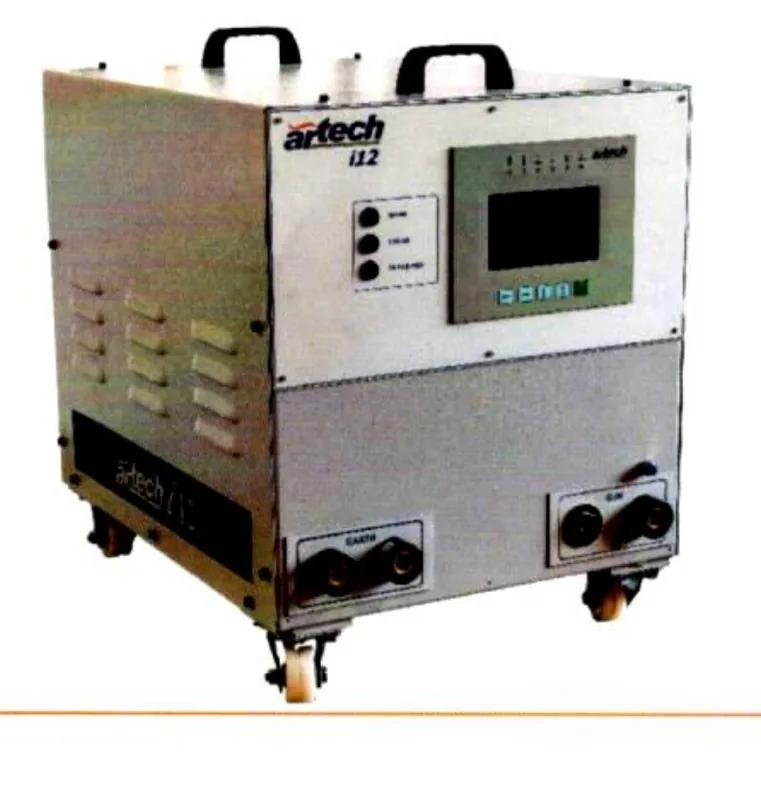
Capacitor discharge and inverter drawn arc stud welding from ARTECH Welders, Pune — M3 to M16, welded from one side in under a second, with no hole through the parent metal.
Stud welding fixes a threaded stud, pin or fastener to a plate in a fraction of a second, welded over its full cross-section, from one side only. It replaces drilling, tapping, riveting and the nut on the back — and on a sealed vessel or a finished panel it is often the only method that does not leave a hole.
We supply the range from ARTECH Welders Private Limited, Pune, who build capacitor discharge and inverter drawn arc stud welding equipment for Indian industry and support it from Delhi, Pune, Bengaluru, Chennai, Ahmedabad, Coimbatore and Raipur.
Nearly every stud welding question comes down to one decision: capacitor discharge or drawn arc. Stud diameter and base-metal thickness decide it, and the two machines are not interchangeable.
A bank of capacitors dumps its charge through a small ignition tip on the end of the stud. The whole weld is over in one to three thousandths of a second, so almost no heat reaches the far side of the sheet.
That is the point of it. ARTECH rate the process down to material about half a millimetre thick, with no mark, no discolouration and no distortion on the show face — nothing to re-work on the other side, and no flux or shielding gas required.
Choose it for M3 to M8 studs on sheet: control and electrical panels, elevator panels, transformer tanks, heat exchangers, insulation pins, cookware and kitchen equipment.
The stud is lifted to draw a pilot arc, the arc melts both the stud end and the parent metal, and spring pressure plunges the stud into the pool. Weld time runs from 10 to 600 milliseconds, long enough to fuse a substantial cross-section.
The result is a full-strength joint, fused across the whole face of the stud and vibration-proof. It needs a heavier base metal to weld into and a three-phase supply.
Choose it for M3 to M16 studs on plate: shear connectors, insulation and cladding pins, automobile and earth-moving fabrication, boiler and power plant work, and anywhere the fastener carries load.
| Model | Process | Stud range | Welding current | Weld time | Supply | Weight | |
|---|---|---|---|---|---|---|---|
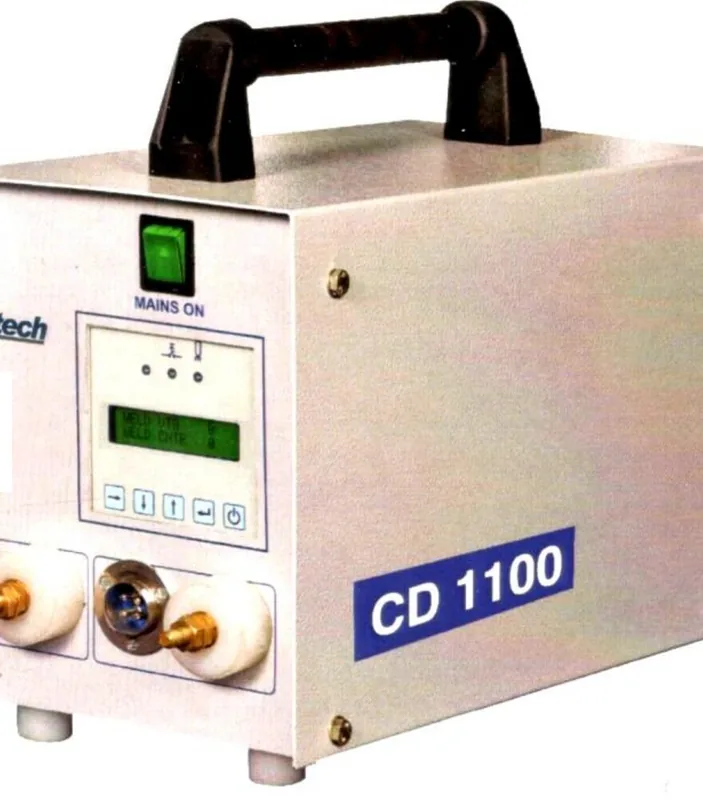
| CD 1100 | Capacitor discharge, tip ignition | M3 – M8 | 66,000 µF bank, 50–200 V charging | 0.001 – 0.003 s | 230 V, 1 ph, 50 Hz | 20 kg | PDFQuote |
| i12 | Inverter drawn arc | M3 – M12 | 800 A max | 10 – 400 ms | 415 V, 3 ph, 50 Hz | — | PDFQuote |
| i16 | Inverter drawn arc | M3 – M16 | 1200 A max | 10 – 600 ms | 415 V, 3 ph, 50 Hz | — | PDFQuote |
Every figure here is from the ARTECH datasheet, which you can open above. The CD 1100 welds up to ten studs a minute depending on diameter. The i12 and i16 take a gap-type gun and a graphic LCD, and carry password protection, a weld counter and self-diagnosis against overheating, input error and internal faults.
Stud welding is rarely bought because someone wants another welding process. It is bought because a fastening operation has become the slow, the expensive or the leaking part of a job:
The work we see most often: control and electrical panels, elevator panels, transformer tank manufacture, heat exchangers, insulation pinning in shipbuilding and ducting, automobile and earth-moving equipment, power plant fabrication, farm equipment and cookware.
Not sure which side of the line your job falls on? Send the stud size, the base metal and its thickness, and whether the reverse face is visible — that is all it takes. Our welding process selection guide applies the same reasoning to the rest of the range.
Material, thickness, quantity and delivery location are all we need to begin. We represent seven authorised brands, so the recommendation you receive is the one the job calls for.